
Brazilian traditions and flavors
Ready-made farofa: origin, preparation, types and a Christmas recipe with banana
Learn the history of farofa, find out how it is prepared and try a special recipe for Christmas.
In this article
Farofa is one of the most traditional side dishes in Brazilian cooking. Present at family lunches, barbecues and year-end celebrations, it brings together flavor, versatility and a lot of history. Here at Da Terrinha, we believe that knowing this tradition makes every meal even more special.
When we think of Brazilian food, few things feel as much like a family lunch as a good farofa: toasted cassava flour, seasoned and often mixed with other ingredients. It sits next to the beans, goes with roast meats, completes the barbecue and gets special versions for celebrations.[2][5]
Made mainly with cassava flour, although there are also corn-based recipes, farofa is one of those side dishes that changes with the region, the occasion and even each family's memories.
And since we believe that knowing what we put on the table makes every recipe even more special, in this article we've gathered a bit of the history of farofa, how it is traditionally prepared, when to choose a traditional or a spicy version and, to finish, a Christmas banana farofa recipe to share.
How is farofa made?
Farofa is generally made with cassava or corn flour, fat and seasonings. From this base, we can add different ingredients and create combinations for every occasion.
When it comes to making farofa, there is no single recipe. In general, we start with heated fat, which can be butter, oil or another fat of choice.
In it, we sauté aromatics such as onion and garlic. Then we add the flour little by little and stir until it absorbs the flavors and reaches the desired texture.[1][6]
Cassava flour is the most widespread base in Brazil, but there are also preparations with corn flour and other regional variations.
From this base, we can create different recipes. Bacon, eggs, herbs, carrot, sausage, nuts, fruit and raisins are just a few possibilities.[7][8]
For a looser, crunchier texture, we avoid excess liquid and keep stirring the flour while it cooks, so it toasts evenly without burning. When we want a moister farofa, we can use ingredients that add fat or moisture to the mix.
It's this freedom to combine that makes farofa such a common side in so many different meals.
With a ready-made farofa, part of this work is already done. In that case, we can serve it straight away or prepare the add-ins separately and mix them in at the end, especially when using fruit or moister ingredients.
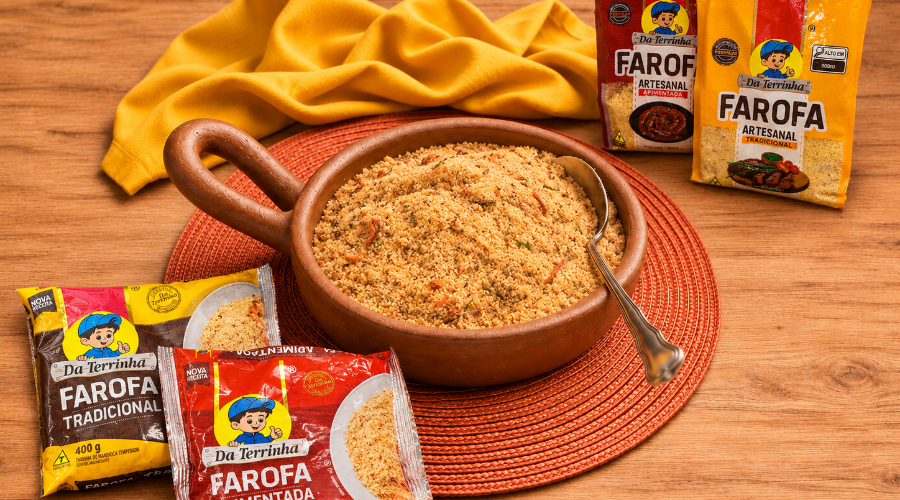
Da Terrinha Ready-Made Farofa, for example, is ready to eat and can be used as a base for new combinations.[11]
For other ways to prepare it, it's also worth checking the seasoned farofa recipes from Receitas Globo (in Portuguese).
Where does farofa come from?
The history of farofa is directly linked to cassava, a food grown and used by Indigenous peoples long before Portuguese colonization. Over time, the dish gained new ingredients and became an important part of Brazilian cuisine.
When we tell the story of farofa, we need to start with cassava.
Growing and processing this root was already part of the food knowledge of Indigenous peoples before the Portuguese arrived. Cassava flour became a hugely important food in the formation of the Brazilian diet.[3]
During the colonial period, it was also widely used in everyday life and as food for travel.
The exact origin of farofa as a dish, however, is not a consensus among researchers.
Some interpretations link it to the meeting between the Indigenous habit of eating cassava flour and sautéing techniques associated with Portuguese cooking.[2][4]
So, instead of attributing its creation to a single person, people or historical moment, we see farofa as a dish built throughout the formation of Brazilian cuisine.
Over time, different regions added their own ingredients and ways of preparing it.
Today we find farofas made with cassava or corn, drier or moister, simple or full of add-ins.
This diversity helps explain why farofa remains so closely tied to our cooking and to shared meals.[5]
To learn more about the historical importance of cassava flour, see the Fundação Joaquim Nabuco article on flour houses and the feature Farofa: uma grande companhia, from Revista Continente (both in Portuguese).
Traditional or spicy farofa: which one to choose?
The main difference between traditional and spicy farofa is the intensity of flavor. While the traditional one goes with many dishes, the spicy one adds a bolder touch to the meal.
When choosing between a traditional and a spicy farofa, we first think about the flavor profile we want to bring to the table.
Traditional farofa: versatility for different meals
Traditional farofa tends to work as a more neutral and versatile choice.
We can pair it with beans, roast meats, poultry, fish, barbecue and dishes with stronger sauces.
Since the side doesn't need to compete with the other flavors of the meal, it is usually a good option for tables with many different dishes.
It's also a good choice when we want to add ingredients such as eggs, vegetables, fruit or nuts.[9]
Spicy farofa: more intensity and personality
The spicy version is a good choice when we want to add intensity.
The heat goes especially well with grilled and roast meats and barbecue, creating a contrast with the juiciness of the food.[10]
We like to think of it this way: if the meal already has strong seasonings or needs to please different palates, the traditional one is a safe choice.
If the idea is to bring more personality and a touch of heat to every bite, the spicy one can take that role.
There is no right or wrong. The best farofa is the one that goes with the rest of the dish and with the taste of the people at the table.
For more pairings, see Oba Hortifruti's tips on what to serve with farofa (in Portuguese).
Christmas banana farofa recipe
Our Christmas banana farofa combines the sweetness of the fruit, the crunch of nuts and the convenience of Da Terrinha Ready-Made Farofa. It's a simple recipe to make your holiday dinner even more special.
During the holidays, we love recipes that combine convenience with the flavor of food made to share.
Farofa is already a common side at Brazilian Christmas dinners, and banana adds a sweet contrast that goes very well with savory dishes.
In this version, we use Da Terrinha Ready-Made Farofa as the base. Since it is ready to eat, we prepare the add-ins first and add the farofa only at the final step.
This way, we can better control the moisture from the banana and preserve the texture of the dish.
Preparation time: about 20 minutes.
Yield: about 6 servings.
Ingredients
- 300 g of Da Terrinha Ready-Made Farofa;
- 3 firm silk bananas (or other firm bananas);
- 1 medium onion, chopped;
- 2 tablespoons of butter;
- 1/3 cup of raisins;
- 1/3 cup of chopped Brazil nuts or cashews;
- 2 tablespoons of chopped parsley;
- Parsley and chives to taste.
Preparation
- Prepare the bananas. Start by cutting the bananas into thick slices or cubes. We prefer firm fruit so it keeps its shape while cooking.
- Sauté the onion. In a large frying pan, melt the butter over medium heat and sauté the onion until soft.
- Add the bananas. Add the bananas and let them brown lightly, stirring gently so they don't fall apart.
- Mix in the add-ins. Add the raisins and nuts and stir for a few more moments.
- Add the farofa. Lower the heat or take the pan off the heat and add Da Terrinha Ready-Made Farofa little by little, coating all the ingredients.
- Finish and serve. Add the parsley and chives, taste to adjust the seasoning and take it to the table right away.
The result is a farofa with different textures and flavors: the sweetness of banana and raisins, the crunch of nuts and the convenience of Da Terrinha Ready-Made Farofa.
For a bigger dinner, we can scale up the recipe keeping the proportions and add other ingredients according to our family's tradition.
Want more combinations? Check out our article on how to pair Farofa Da Terrinha with different ingredients.[12]
Da Terrinha to your table
Whether at an everyday lunch, a barbecue or Christmas dinner, farofa is a delicious way to bring flavors, traditions and people together at the table.
Farofa has crossed generations precisely because we never have to make it the same way every time.
It can be simple at everyday lunch, get some pepper at the barbecue or take fruit, nuts and herbs when we want a more festive table.
This ability to adapt to different dishes is part of the history of Brazilian farofa itself.
Here at Da Terrinha, we want to make these moments easier without losing the pleasure of creating at the table.
Our Da Terrinha Ready-Made Farofa can be served as is or transformed with the ingredients of your favorite recipes.
So, at your next family lunch, barbecue or Christmas dinner, we invite you to try new combinations.
Serve, mix, invent and put a bit of your own style into every dish.
Because, for us, Brazilian food is even better when it brings together flavor, tradition and good stories around the table.
From our land to your table
More flavor and convenience for your recipes.
Discover Da Terrinha Ready-Made Farofa and find new ways to bring tradition and flavor to your meals.
Discover Da Terrinha Ready-Made FarofaSources and references
Materials consulted to write this article.
- Folha de S.Paulo — The importance of good flour for farofa recipes (in Portuguese)traditional preparation, texture and the role of flour in Brazilian cooking.
- Sesc São Paulo — Farofada boa (in Portuguese)historical and cultural context of farofa in Brazilian food.
- Fundação Joaquim Nabuco — Casa de Farinha (in Portuguese)origin of cassava flour and the importance of Indigenous knowledge.
- Revista Continente — Farofa: a great companion (in Portuguese)history of farofa and its different ways of preparation.
- Folha de S.Paulo — If it's not farofa, it's not food (in Portuguese)the place of farofa in Brazilian food culture.
- Caieiras City Hall — Basic Cook Course: National Cuisine (in Portuguese)guidance on basic preparation and ingredient combinations.
- Receitas Globo — Seasoned farofa (in Portuguese)reference for ingredients, preparation and variations of farofa.
- Receitas Globo — Farofa, from Mais Você (in Portuguese)examples of preparation with different ingredients and seasonings.
- Oba Hortifruti — Where to use farofa? 5 tips (in Portuguese)pairing suggestions for different types of farofa.
- CPT — Farofa is an essential side for barbecue (in Portuguese)versatility of farofa and its pairings with meat.
- Da Terrinha — Traditional Ready-Made Farofa 400 gofficial information about the ready-to-eat product.
- Da Terrinha — Farofa Da Terrinha: combinations to add flavor to your tablepairing ideas with ready-made farofa.