Fun facts and recipes
Potatoes and potato sticks: a crunchy journey from their origins to the Brazilian table
Discover the history of the potato, its different cuts and the crunch of Da Terrinha Potato Sticks.
In this article
Few ingredients can change personality as much as the potato. It can reach the table soft, in a purée; golden, fresh from the oven; cut into generous sticks; turned into a Spanish tortilla; or thin, dry and crunchy, ready to complete that dish that seemed to be asking for something more. Native to the Andes region and cultivated in South America for thousands of years, the potato crossed oceans and became one of the most consumed foods in the world.
And when this story reaches Brazil, a question comes up that almost everyone understands right away: Why do Brazilians love batata palha — potato sticks — on everything?
Perhaps because here it found a combination that is hard to resist: convenience, flavor and, above all, texture. Stroganoff becomes more interesting, salpicão (Brazilian chicken salad) gains contrast, hot dogs get that signature crunch, and even recipes that traditionally don't include potato sticks end up making room for them. Here at Da Terrinha, we know how small details can transform a meal. That's why our Extra-Fine Potato Sticks are a great companion for different moments at the table.
But before opening the bag, it's worth going back a few centuries — and a few thousand kilometers — to discover how a tuber from the Andes ended up becoming one of the favorite crunchy toppings on the Brazilian table.
From the Andes mountains to a journey around the world in potato cuts
Despite the name "batata-inglesa" (English potato) used in Brazil, the potato was not born in England. Its origin is in the Andes mountain range, in South America. Embrapa points out that native peoples were already eating and growing potatoes more than 8,000 years ago; the tuber reached Europe around the 16th century and then spread to other regions of the planet. Today, the International Potato Center ranks it as the third most important food crop in the world for human consumption, behind only rice and wheat.
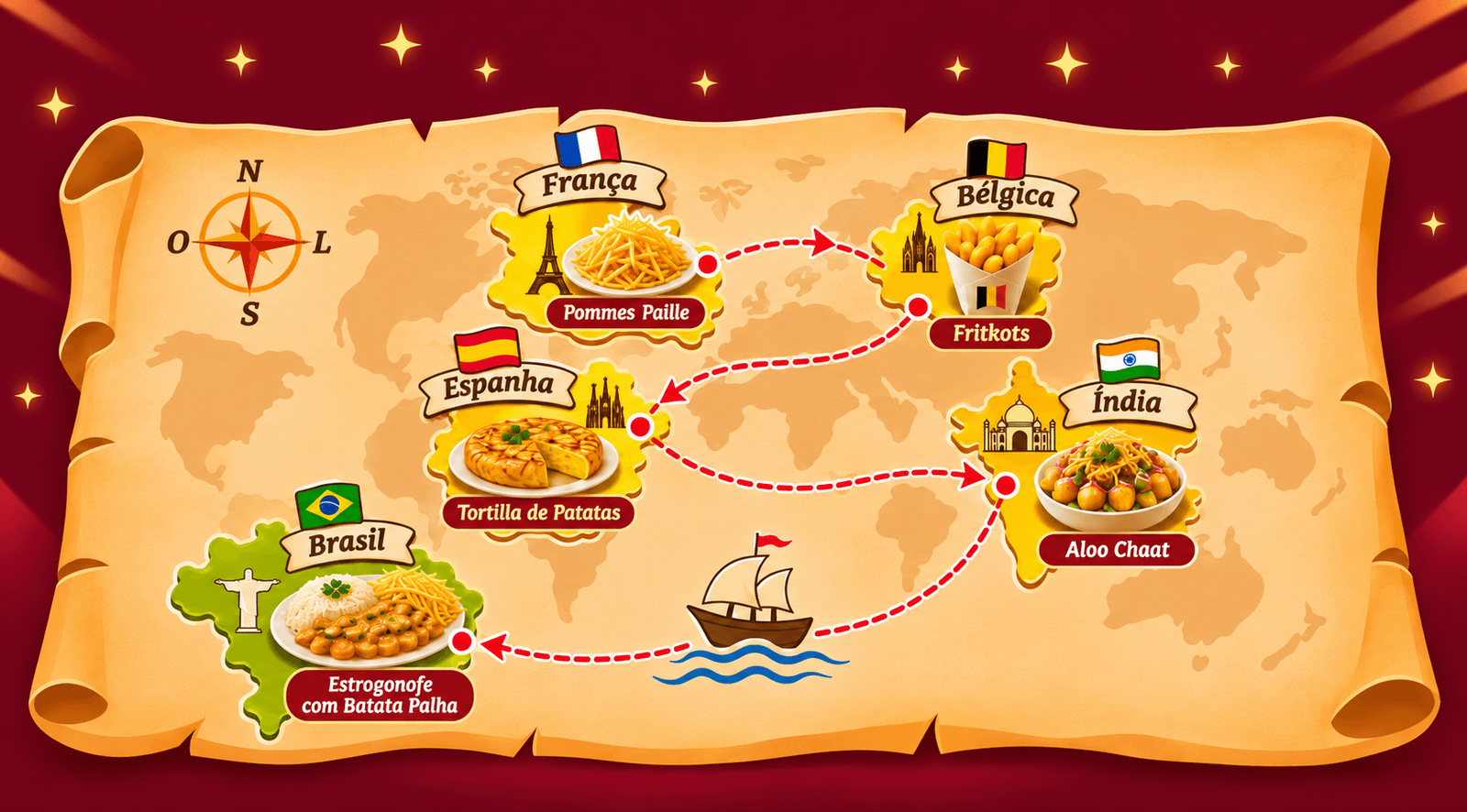
And it was on this journey that each cuisine found its own way to cut, fry, roast or transform the potato.
In France, classic gastronomy created a true language of cuts. Among them are pommes paille: potatoes cut lengthwise into very thin strands and then fried. The Dictionary of the French Academy itself records this definition, and the name refers precisely to the appearance of small strands of straw.
In Belgium, the star is frites, so embedded in everyday life that the traditional fry shacks, the fritkots, are part of the regionally recognized cultural heritage of the country. The historical origin of French fries is still disputed between France and Belgium, so it is best to avoid naming a definitive "inventor". What is not in doubt is the cultural importance that fries have acquired in Belgian cuisine.
In Spain, the potato changes shape again: it appears sliced and cooked together with eggs in the traditional tortilla de patatas and also fried in chunks in the popular patatas bravas. Spain's official tourism portal lists the tortilla among the country's great gastronomic symbols.
In India, it is called aloo in many culinary contexts and appears in preparations ranging from spiced, sautéed potatoes, such as aloo gutke, to the fried cubes of aloo chaat and potato-based doughs and dumplings.
And then we arrive in Brazil, where thin strands of potato took on a life of their own. Here, potato sticks stopped being just a European-inspired garnish and found their place in stroganoffs, salpicões, fricassês, hot dogs, pies and countless family recipes. Industrial-scale production of potato sticks in Brazil began to gain ground in the second half of the 20th century, although pommes paille preparations were already documented in French-tradition kitchens long before that.
In a way, the potato's journey around the world ends exactly where this story began: with a handful of golden strands on the plate.
When the potato became straw — and is there such a thing as sweet potato sticks?
The exact origin of potato sticks doesn't fit into a simple story like "it was invented by a certain person in a certain year". What the historical record allows us to say with more confidence is that French preparations called pommes paille, made with very thin strands of fried potato, were already established in the culinary repertoire of the 19th century. A cookbook published by Charles Ranhofer in 1894, for example, already described "julienne or straw" potatoes, distinguishing straw potatoes by their even thinner strands.
In Brazil, academic studies on potato processing record the industrial development of the straw and chip versions from the 1960s onwards. This helps explain why, here, potato sticks became a supermarket product and an everyday side dish in a way that did not happen with the same intensity in other countries.
What about sweet potato sticks?
If we are talking about sweet potato cut into thin strands and cooked until crunchy, yes. There are contemporary recipes for sweet potato sticks, including baked ones, following the same logic of turning the tuber into thin, crunchy strips.
Although we don't know when or where this version appeared, we can consider it an adaptation of the traditional straw cut and one more example of the versatility of potatoes in the kitchen.
From tradition to the Brazilian table: a crunch that goes with almost everything
The great charm of potato sticks lies precisely in contrast. A smooth cream becomes more interesting with something crunchy on top; a moist dish gains new texture; a simple recipe gets a different finish in a few seconds.
That's why they seem to have found a second home in Brazilian cooking.
In stroganoff, potato sticks contrast with the creamy sauce and usually share the plate with rice. In Brazilian fricassê recipes, they also appear as a crunchy finish.
In salpicão, they are usually added at serving time to preserve their crunch. In escondidinho (a Brazilian purée-topped casserole) recipes, they can work as a topping or finish, bringing texture to the purée. And it doesn't have to stop there: potato salads, savory pies, omelets, sandwiches and even bowls can get a thin crunchy layer.
It is precisely in these moments that our Da Terrinha Potato Sticks make a difference. Made with potato, vegetable oil and refined salt, they come ready to eat, bringing convenience to the preparation of our meals.
To make the most of their crunch, we have a special tip: add the potato sticks only at the finishing stage or when serving. That way, we avoid prolonged contact with sauces and moist ingredients and keep their texture for longer.
Myths and facts: are potato sticks fattening?
Let's start with the most common myth.
"Are potato sticks fattening?"
No single food alone determines weight gain or loss. Body weight is influenced by the diet as a whole, energy expenditure, physical activity and several individual and environmental factors. In energy terms, weight gain tends to occur when energy intake persistently exceeds the body's expenditure.
This does not mean that all potato preparations are nutritionally the same. The way they are prepared changes the energy density of the food considerably, especially when there is frying and oil absorption.
So where are the benefits of potatoes?
Fresh or in simple preparations, potatoes provide carbohydrates as well as nutrients such as potassium, vitamin C and B vitamins, although the amounts vary according to variety, storage and cooking method. Embrapa highlights the potato as a source of potassium, vitamin B3 and, among underground starchy foods, vitamin C.
That's why we can include potato sticks in a balanced diet, taking into account portions, frequency of consumption and the other foods that make up our meals.
Can you make potato sticks at home?
Yes! Now that we know a little more about their history, characteristics and possibilities in the kitchen, how about learning to make our own potato sticks?
The secret lies in the thickness of the strands, removing some of the surface starch and drying them properly before frying.
Start with potatoes cut or grated into very thin strips. Then they sit for a few minutes in cold water to remove some of the surface starch, are dried very well and then fried until golden. Reference recipes even use two-stage frying, first at around 160 °C (320 °F) and then close to 180 °C (356 °F), while others fry directly in oil at approximately 180 °C.
To make them at home, you can follow a simple version:
- Wash the potatoes and peel them, if you prefer.
- Cut them into a very thin julienne or use a suitable grater.
- Place the strips in cold water for a few minutes.
- Drain and dry them very well with a clean cloth or paper towels — water and hot oil are a dangerous combination.
- Fry in small batches in hot oil, at around 180 °C (356 °F), until golden.
- Remove, drain on absorbent paper and season with salt after frying.
You can also make versions in the air fryer or even baked sweet potato sticks, although the texture and flavor are different from traditional frying.
Making potato sticks at home can be a fun experience, especially when we have time to explore new recipes.
But we know that, in the rush of everyday life, convenience makes all the difference. With our Da Terrinha Potato Sticks, we can skip the cutting, washing, drying and frying steps and go straight to the tastiest part: finishing our dishes and enjoying every bite.
Smart storage: from the fresh potato to the last crunchy strand
Knowing how to store our potatoes correctly is just as important as knowing how to prepare them. After all, we want to make the most of our ingredients, preserving their characteristics and avoiding waste.
For home consumption, Embrapa recommends keeping potatoes in a cool, airy and dark place, protected from light to prevent greening. Exposure to light can favor the formation of compounds such as solanine in the green parts, which should not be eaten. Under suitable home conditions, they can stay out of the refrigerator for about two weeks, although the recommendation is also to buy amounts compatible with consumption to avoid losses.
A ventilated pantry, preferably with the potatoes in a paper bag or mesh bag, is usually a better solution than leaving them exposed to the sun or in a closed plastic bag.
And once the bag of potato sticks is open?
Here at Da Terrinha, we recommend that our Extra-Fine Potato Sticks be stored at room temperature and, after opening, kept in a closed container in a cool, airy place.
This care is essential because moisture and crunch are not good friends.
By properly closing the container after each use, we reduce the product's contact with ambient moisture and help preserve its texture.
If our potato sticks have lost their crunch only because they absorbed a little moisture, we can still try to recover their texture, as long as they are within the expiration date, have been stored correctly and show no signs of spoilage.
To do this, we can spread them in a thin layer and put them in the oven or air fryer for a short time, watching the process closely so they don't burn.
Dry heat can help reduce moisture and recover some of the crunch.
However, we need to remember that this procedure does not recover spoiled food. If we notice changes in smell or appearance, signs of mold, or have doubts about the storage conditions, we should discard the product.
From Da Terrinha to our table: more flavor and crunch in every moment
Throughout this journey, we discovered that few foods have crossed so many centuries, countries and cultures without losing their ability to reinvent themselves.
From the Andes to our kitchens, the potato has taken on different shapes, flavors and textures. And when it arrives thin, golden and crunchy, it finds a special place on the Brazilian table.
From Sunday stroganoff to holiday salpicão, from escondidinho to a loaded hot dog, we know there is always a dish waiting for that finishing touch.
With Da Terrinha Potato Sticks, we want to be part of these moments, bringing more convenience, flavor and crunch to everyday meals.
From our land to your table
More flavor and crunch with Da Terrinha.
Discover Da Terrinha products and give your recipes a special touch.
Discover Da Terrinha Potato SticksSources and references
Materials consulted to write this article.
- Embrapa HortaliçasTechnical materials on the origin, history, nutritional characteristics, consumption and storage of potatoes.
- International Potato Center (CIP)Information on the origin, history and importance of the potato in the world's diet.
- Dictionnaire de l’Académie françaiseDefinition of pommes paille and characteristics of the traditional French cut.
- RANHOFER, Charles. The Epicurean. 1894Historical reference on julienne and straw potato cuts.
- Spain.info — Official Tourism Portal of SpainReferences on Spanish gastronomy and the traditional tortilla de patatas.
- Brazilian Food Composition Table (TBCA) — USP/FoRCNutritional references on potatoes and their different forms of preparation.
- PanelinhaCulinary references on home cooking techniques for potatoes and potato sticks.
- Receitas GloboCulinary references on the use of potato sticks in Brazilian dishes and on sweet potato sticks.